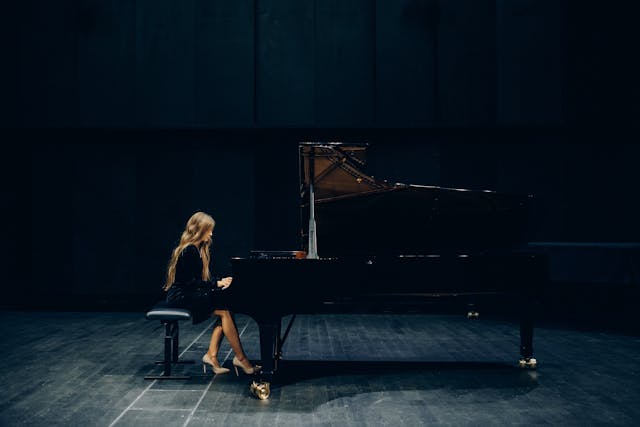
The piano, often hailed as the king of musical instruments, owes much of its expressive power to a trio of unassuming devices at the performer’s feet: the pedals. These mechanisms—typically the sustain, soft, and sostenuto pedals on a modern grand piano—enable musicians to shape dynamics, tone, and resonance, transforming the instrument’s voice from delicate whispers to roars. In this article, we explore the historical evolution of piano pedals, their distinct functions, and their artistic impact, with a special focus on Ludwig van Beethoven’s Sonata No. 14 in C-sharp minor, Op. 27 No. 2 – the so-called “Moonlight” Sonata – as a striking example of their transformative power.
Historical evolution
The story of piano pedals begins with the instrument’s invention around 1700 by Bartolomeo Cristofori, an Italian harpsichord maker employed by the Medici family in Florence. Unlike the harpsichord, which produced sound at a fixed volume, Cristofori’s piano allowed dynamic variation – piano (soft) and forte (loud). His early designs included knee levers to lift dampers (felt-covered pads that stop string vibrations), sustaining notes longer. This was the precursor to the modern sustain pedal, a critical innovation for expressive playing.
By the late 18th century, as pianos spread across Europe, English makers like John Broadwood replaced knee levers with foot pedals for greater ease. The damper pedal, now known as the sustain pedal, became standard by the 1770s, enabling composers like Mozart to explore sustained harmonies. Around the same time, the soft pedal (una corda) emerged, shifting the hammers to strike fewer strings for a muted tone. The third pedal, the sostenuto, arrived later, patented in 1844 by French maker Jean-Louis Boisselot and popularized by Steinway & Sons in the 1870s. It selectively sustains specific notes, leaving others unaffected—a boon for complex textures.
In the 19th century, as pianos evolved with iron frames and heavier strings, pedals adapted to handle increased resonance. Romantic composers like Chopin and Liszt used the sustain pedal for lush, blurred effects, though some critics cautioned against overuse for clarity’s sake. By the 20th century, pedals were integral to diverse styles, from Debussy’s impressionistic soundscapes to jazz improvisations. Today, while upright pianos may feature a middle practice pedal to mute volume, the core trio remains a hallmark of grand pianos.
The functions of piano pedals
Each pedal serves a unique role, expanding the piano’s sonic possibilities:
- Sustain Pedal (Right): The most versatile, this pedal lifts all dampers, allowing strings to vibrate freely after keys are released. This creates resonance, blends notes into chords, and enables smooth legatos. It also amplifies overtones, enriching timbre. Skilled pianists use half- or quarter-pedaling, fluttering the pedal to balance clarity and sustain. Marked as “Ped.” in scores, it’s the cornerstone of expressive pedaling.
- Soft Pedal (Left, Una Corda): This pedal softens volume and alters tone. On grands, it shifts the action so hammers strike two strings per note instead of three (or one instead of two in the bass), producing a veiled, intimate sound. On uprights, it moves hammers closer to strings for a similar effect. It’s ideal for delicate passages requiring warmth and subtlety.
- Sostenuto Pedal (Middle): Found primarily on grands, this pedal sustains only the notes played when it’s depressed, leaving subsequent ones unaffected. It’s invaluable for layered textures in modern works by composers like Bartók or Prokofiev, allowing precise control over sustained chords.
These functions give pianists a palette to paint with sound, from thunderous climaxes to ethereal whispers.

The “Moonlight” Sonata
To illustrate the pedals’ artistic impact, consider Beethoven’s Sonata No. 14 in C-sharp minor, Op. 27 No. 2, composed in 1801 and named the “Moonlight” Sonata by critic Ludwig Rellstab in 1832. Rellstab’s poetic comparison to moonlight on Lake Lucerne belies Beethoven’s intent, as he subtitled it Sonata quasi una fantasia for its improvisatory structure. This work, particularly its first movement, showcases how pedals elevate simple notes into profound expression.
Beethoven’s manuscript for the Adagio sostenuto first movement includes a remarkable instruction: “si deve suonare tutto questo pezzo delicatissimamente e senza sordino” – play with great delicacy and without dampers. Here, “sordino” refers to the dampers, not the soft pedal (which he would have called una corda). Beethoven demands the sustain pedal be held throughout, lifting dampers to let harmonies blend in a hazy, resonant wash. This creates a “swimming” sonority where overtones reinforce each other, evoking not moonlight but a funeral scene, as pianist András Schiff suggests, drawing from Mozart’s Don Giovanni. The movement’s triplet ostinatos, pedal points, and dotted funeral march rhythm, all in pianissimo, gain depth through this pedaling.
On period fortepianos, this effect was shimmering yet controlled. Critics argue it’s unfeasible on modern pianos due to their louder, longer sustain, but Schiff proposes partial pedaling – depressing the pedal a third of the way – to achieve Beethoven’s vision without muddiness. The result is a restored “painting,” its colors vibrant yet blurred, like a Bach prelude with sparse melody and Napolitan harmonies for tension.
The second movement, a minuet in D-flat major, contrasts sharply by omitting the pedal, offering “clear fresh air” after the first movement’s fog. Franz Liszt called it “a little flower between two huge abysses,” its staccato and legato variations providing relief. The Presto agitato finale, in sonata form, uses pedaling selectively – Beethoven marks con sordino and senza sordino to sustain specific chords, building menace and crescendos. This culminates in a visionary coda, resembling a piano concerto cadenza, where pedaling balances the sonata’s architecture.
Beethoven, the first composer to notate pedaling precisely, used it to ensure the slow opening and brief middle movement counterweight the explosive finale, demonstrating the pedals’ structural and emotional role.
From Cristofori’s knee levers to today’s sophisticated mechanisms, piano pedals have evolved into indispensable tools for musical expression. The sustain pedal creates resonance and continuity, the soft pedal adds intimacy, and the sostenuto pedal offers precision for complex textures. Far from mere mechanical aids, they are the brushstrokes of the pianist’s art.


